Narcissus
Metamorphoses (Ovid Edition)Narcissus is the beautiful, emotionally inaccessible youth at the center of a tragedy of self-love. Desired by the nymphs yet unmoved by their caresses, he remains lovely but coy, and his refusal of reciprocal affection becomes the condition of his ruin. The story gives that inward turning a physical image: a solitary fountain in a dark wood, where Narcissus encounters beauty that cannot answer him and from which he cannot withdraw.
Identity and Introduction
Narcissus first appears through the contrast between his beauty and his detachment. The nymphs approach him with affection and attempt to caress him, but their efforts are vain. He does not become less beautiful through this refusal; rather, his continued loveliness makes his coldness more striking. The narrative presents him as a figure whose visible perfection is accompanied by a failure of relation: he can be admired, but he does not return admiration or affection.
His coyness is not merely a passing mood. It establishes the defining imbalance of his character. Others reach toward him, while he remains closed to them, and the repeated failure of their approach prepares the story’s reversal. Narcissus will eventually become the one who longs for an image, but the object of his longing will offer him no more response than he previously offered to the nymphs.
Punishment and the Fountain
The neglected nymphs’ suffering receives a response from Rhamnusia, who pities their condition and answers their prayer with just vengeance. Narcissus’s fate therefore emerges from the injury caused by his indifference, but it is enacted through an external power that converts his own manner of being into his punishment. The story’s justice is exact: the youth who refuses the desire of others is made captive to a desire that cannot be fulfilled.
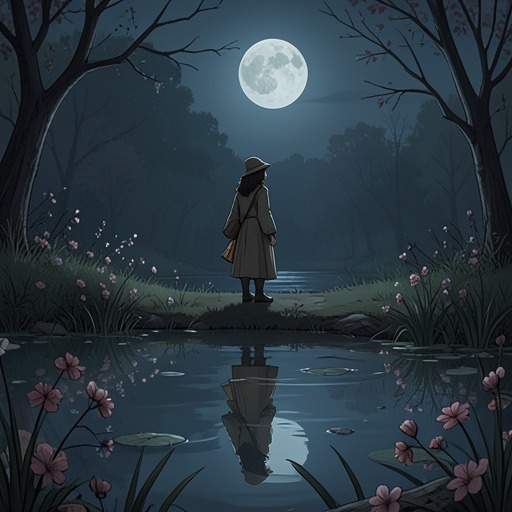
The instrument of this reversal is a fountain standing in a darksome wood. Its water is unusually undisturbed, neither stained by falling leaves nor muddied by rising earth, and it rests beyond the disturbance of wind. The fountain’s stillness creates a perfect reflective surface, isolating Narcissus from ordinary movement and placing him before an image that appears clear because the world around it has been suspended. The setting is not incidental scenery; it provides the condition under which self-recognition becomes obsession.
Self-Love and Descent
At the fountain, Narcissus encounters an image whose beauty captures him. The reflection answers his own appearance with an apparently ideal counterpart, but it cannot offer the reciprocal affection he once denied. His desire thus turns upon an impossible object: he seeks closeness to an image that remains bound to the water’s surface and cannot become a living companion.
This reversal gives the tale its tragic structure. Narcissus does not simply admire himself from a safe distance; he is drawn into a relationship in which recognition and misrecognition coincide. He sees a beautiful being, yet the beloved cannot be separated from his own image. The more completely the reflection satisfies his eye, the more completely it denies the mutuality that love requires. His former coyness returns in transformed form: he is now the excluded lover, shut out by the very beauty that enthralls him.
The punishment also exposes the limits of beauty as a basis for identity. Narcissus’s appearance can command attention, but it cannot create another person where there is only an image. His tragedy lies in mistaking visual perfection for companionship and in discovering, too late, that desire directed wholly toward the self produces isolation rather than possession.
Death, Transformation, and Mourning
Narcissus’s story ends in death. His ghost withdraws to the cold shades and continues to admire itself in the Stygian waves, carrying the pattern of self-absorption beyond bodily life. Even in the underworld, the reflected image remains his chosen object, so death does not immediately break the cycle that defined him.
Yet the ending does not leave Narcissus alone. The Naiads and Dryads mourn him, and the sorrow of the nymphs is answered by sad Echo. The sister-nymphs prepare his urn, turning the youth once desired into an object of communal grief. Their mourning restores a social dimension that Narcissus himself had rejected: his life had refused the bonds offered by others, but his death draws those others together around his remains.
The story’s transformation is therefore both personal and ecological. Narcissus passes from a beautiful youth into a figure preserved by water, voice, and mourning. His fate links the fountain’s still image with Echo’s repeated sound and with the nymphs’ grief, making self-love part of a larger landscape of reflection, reverberation, and loss. His decisive significance lies in this reversal: the youth who would not answer desire becomes the emblem of desire trapped within its own image, while the world around him remembers what he could not reciprocate.